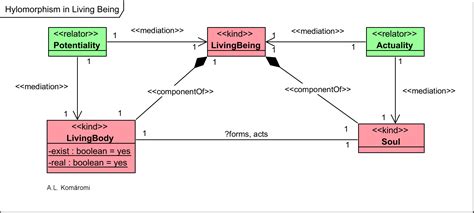
Introduction to Hylomorphism

Hylomorphism is a philosophical concept that originated with Aristotle, focusing on the nature of reality and how things exist. The term “hylomorphism” comes from the Greek words “hyle,” meaning matter, and “morphe,” meaning form. This philosophy attempts to explain how matter and form combine to create the substances and objects we encounter in the world. At its core, hylomorphism is an effort to understand the essence of things, how they come to be, and what constitutes their being.
Key Components of Hylomorphism

To grasp hylomorphism, it’s essential to understand its two primary components: matter (hyle) and form (morphe). - Matter refers to the potential or the raw material out of which something is made. It is the stuff that can be shaped or formed into something else. In Aristotle’s view, matter is pure potentiality; it has the potential to become many things but is not yet anything specific. - Form, on the other hand, is what gives matter its specific identity or essence. It is the structure or organization that makes something what it is. Form is actuality; it is what makes matter into an actual, existing thing.
For example, consider a piece of marble. The marble itself is the matter, having the potential to become many different sculptures. The form is the specific shape or design that a sculptor imposes on the marble, turning it into a particular statue. Without the form, the marble remains just a raw, unshaped piece of material.
The Concept of Potentiality and Actuality

Aristotle’s hylomorphism also heavily relies on the concepts of potentiality and actuality. Potentiality refers to the capacity or possibility of something to become something else, while actuality is the realization of that potential. - Potentiality is associated with matter, as it has the potential to become many different things. - Actuality is associated with form, as it is the realization of that potential, making something into what it actually is.
This dichotomy is central to understanding how change occurs in the world according to hylomorphism. When matter takes on a form, it moves from a state of potentiality to one of actuality. This transition from potential to actual is what constitutes change or becoming in Aristotle’s philosophy.
Critique and Influence of Hylomorphism

Over the centuries, hylomorphism has faced various critiques and has influenced numerous philosophical and scientific developments. - Critiques often focus on the difficulty of defining matter and form in a way that is universally applicable. Some argue that the distinction between matter and form is not as clear-cut as Aristotle suggested, particularly in light of modern scientific discoveries about the nature of matter and energy. - Influence can be seen in the development of medieval philosophy, particularly in the works of Thomas Aquinas, who integrated Aristotle’s ideas with Christian theology. Hylomorphism has also had an impact on the philosophy of science, as it pertains to discussions about the nature of reality, the relationship between parts and wholes, and the process of change.
Modern Applications and Analogies

While hylomorphism is an ancient philosophy, its concepts and principles can be applied to modern contexts and technologies. For instance, the relationship between hardware (matter) and software (form) in computing can be seen as a contemporary analogy to Aristotle’s hylomorphism. The hardware provides the physical basis (matter), while the software gives it its functional form, determining what the computer can do.
| Component | Ancient Analogy | Modern Analogy |
|---|---|---|
| Matter | Marble | Computer Hardware |
| Form | Sculpture Design | Computer Software |

📝 Note: The analogy between ancient and modern concepts is not perfect but serves to illustrate how hylomorphic principles can be applied across different domains.
Conclusion and Final Thoughts

In summary, hylomorphism offers a profound way to think about the nature of reality, emphasizing the interplay between matter and form. While it is rooted in ancient Greek philosophy, its concepts remain relevant today, influencing discussions in philosophy, science, and beyond. The essence of hylomorphism lies in its attempt to explain how potential becomes actual, how matter takes on form to create the world we experience. As we navigate the complexities of modern life and technology, revisiting and applying these timeless principles can offer valuable insights into the fundamental questions of existence and reality.
What is the main focus of hylomorphism?

+
Hylomorphism primarily focuses on understanding the nature of reality through the relationship between matter (potential) and form (actuality), explaining how things come to be and what they are.
How does hylomorphism explain change?

+
According to hylomorphism, change occurs when matter moves from a state of potentiality to actuality by taking on a form. This transition from potential to actual is what constitutes change or becoming.
What are some modern applications of hylomorphism?
+
Hylomorphism can be applied to modern contexts such as the relationship between computer hardware (matter) and software (form), illustrating how form gives matter its specific functions and identity.